
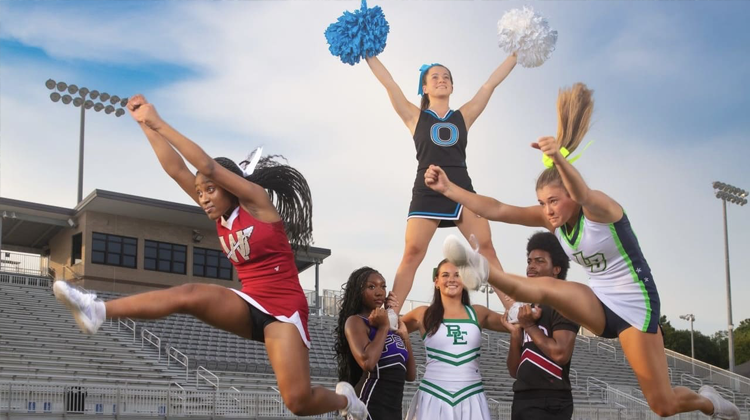
Behind the bows, stunts and Friday night lights, Mount Pleasant’s high school cheerleaders are building something bigger than a team: community.
On a Friday night in Mount Pleasant, the cheerleaders are easy to spot.
They are standing on the sidelines beneath the stadium lights, rallying the crowd, supporting their classmates and helping turn a football game into something bigger than what happens on the field. But what the community sees during those few hours is only a small part of what it means to be a high school cheerleader.
Behind every routine are hours of practice. Behind every stunt is trust. Behind every uniform is a team of young women learning how to work together, lead one another and represent something larger than the individual.
Across Mount Pleasant’s high schools, cheer programs may look different, but the coaches leading them describe a remarkably similar purpose: creating a place where athletes can find their people while becoming stronger, more confident versions of themselves.
A TRADITION THAT KEEPS GROWING
The story of high school spirit in Mount Pleasant is also a story of a community that has grown and changed.
For decades, Wando High School was the town’s primary public high school. The school opened in 1973, following a period of school integration and a reshaping of Mount Pleasant’s educational landscape. As the community continued to grow, so did the need for more schools. Lucy Beckham High School opened in 2020 as Mount Pleasant’s second comprehensive public high school, creating a new school identity and new traditions to build from.
On the other side of the Cooper River, Bishop England brings a much longer institutional history. Founded in 1915, the school spent decades in downtown Charleston before moving to its current Daniel Island campus in 1998. Today, its cheerleaders are part of a school community whose traditions stretch back more than a century.
Oceanside Collegiate Academy and Philip Simmons High School represent newer chapters in the area’s educational landscape, with cheer programs continuing to grow alongside their schools and communities.
That mix of old and new is part of what makes Mount Pleasant’s cheer landscape so interesting. Some programs are carrying forward generations of school spirit, while others are still creating traditions their younger athletes will eventually pass down.
At Wando, that tradition begins even before many athletes officially join the high school team.
 Head coach Rhiannon Mansfield said many of her cheerleaders grew up through Wando’s cheer pipeline, attending Little Warrior camps as kindergartners and elementary-aged students before eventually becoming part of the high school program. “We are truly a family,” Mansfield said.
For some athletes, that family extends well beyond graduation. Mansfield said former Wando cheerleaders have carried their friendships into college, with some even becoming roommates.
Whether a cheerleader is stepping into a tradition decades in the making or helping create one for the first time, the role remains remarkably similar: show up, support your school and make the people around you feel like they belong.
 MORE THAN THE SIDELINES
From the outside, cheerleading can be easy to underestimate. The cheers and dances may be the most visible part, but coaches noted that there is far more happening behind the scenes.
At Bishop England High School, second-year coach Emma Johnston said her athletes spend countless hours drilling and repeating stunts, tumbling and jumps. This season, the team has been especially focused on timing and trust. “They’re trusting the coaching staff, trusting their teammates and trusting themselves,” Johnston said.
 That trust is not optional when athletes are depending on one another in the air.
Lucy Beckham High School head varsity coach Mackenzie Spraker sees the same athletic demands in her athletes. Beckham’s team practices four to five days a week and trains consistently for competition through the end of November while simultaneously navigating football season.
Spraker wishes more people understood just how much athleticism cheer requires. “It combines gymnastics, acro,” she said. “It’s not just spirit.”
 Philip Simmons High School head coach Brittani Williams said the intricacy of the sport is similarly misunderstood. “You often hear people say, ‘Oh, cheering is so easy. You just go out there and you cheer on your team,'” Williams said. “But there’s really some complexity that goes behind the stunts and the tumbling that I don’t think people really realize.”
Her athletes spend time in the gym during the summer and even on Sunday evenings working on those skills.
The work does not end once football season begins. Williams described cheer as almost two seasons in one, with different preparation required for football and basketball. There are cheers to learn, stunt groups to develop, band dances to practice, banners and flags to coordinate and countless small details that must come together before game day.
“It’s not just, ‘We go out there and cheer,'” she said.
At Wando, Mansfield’s team is preparing for its own competitive challenge. She described this year’s athletes as determined, talented and eager to push boundaries. After South Carolina restructured its classifications, Wando is back in 4A, the same division where the program previously won a state championship.
For the athletes, the change represents a new opportunity. “They are true go-getters with a lot of spunk,” Mansfield said.
LEARNING TO TRUST
The physical demands of cheer may be what make the sport challenging, but the relationships between teammates are what make it work.
For Spraker, trust is especially important within stunt groups. Every athlete has to know that her teammates will do their part. “Trust is so important or the stunts don’t work,” she said.
That trust develops over time, through repetition and shared experiences. It also creates something that extends beyond the mat.
Spraker said Beckham’s athletes spend nearly every waking minute together, carpooling, practicing and attending games. Their families become part of that world, too. “The cheer moms are a big part of the sport,” she said.
Williams sees that same sense of connection as an important part of the experience. Her seniors at Philip Simmons are expected to help younger athletes and the junior varsity team, teaching cheers, setting expectations and leading by example.
For her, leadership is not about a title. It is about showing up prepared, holding yourself and your teammates accountable and setting the standard for the people around you.
These lessons, she said, extend well beyond high school. “You have to be able to work with people,” Williams said. “You have to have conflict resolution.”
She hopes her athletes leave the program knowing how to communicate, take responsibility and work with people from different backgrounds, skills they will need in college and in the workforce.
Johnston has similar hopes for her Bishop England athletes. Her goal is not simply to create good cheerleaders, but “polite, respectful, well-rounded young women.”
The older athletes, she said, have an opportunity to model that for the younger girls, while the coaching staff sets the expectation for what good leadership looks like.
At Wando, Mansfield sees that same sense of family developing across generations of athletes. Many of the girls have known one another through the program since they were children, creating relationships that can grow alongside their cheer careers.
FINDING YOUR PEOPLE
For many athletes, the relationships built through cheer become just as important as the sport itself.
Johnston described the culture at Bishop England as a sisterhood. Her athletes can turn to one another and their coaches for support and guidance, creating a team environment where the girls know they are not navigating the experience alone.
At Beckham, that closeness develops naturally from the amount of time the athletes spend together, while at Philip Simmons, it is reinforced through the relationship between older and younger athletes.
 Oceanside Collegiate Academy head cheer coach Tricia Hargrove said team-building is an intentional part of building a successful program. The team works to establish connections among athletes and families, creating a community around the program rather than simply a group of students who practice together.
That sense of belonging can be particularly meaningful during the high school years, when athletes are figuring out who they are and where they fit.
For Johnston, that is part of what she hopes her athletes ultimately gain from cheer. She wants them to become confident athletes, but also respectful, accountable and well-rounded young women.
PROUD TO REPRESENT
Cheerleaders are often among the most visible representatives of their schools. They are there when the crowd arrives, when the team takes the field and when the final whistle blows.
THAT VISIBILITY COMES WITH RESPONSIBILITY
At Bishop England, Johnston said her athletes take pride in representing their school and supporting their fellow athletes. “I think the girls are really proud to be part of the Bishop England community,” she said. “Cheerleading and showing their support for other sports as well as themselves is a great thing.”
Spraker sees the same pride developing in a young Lucy Beckham program that is still creating its identity. As a newer school, it is working to establish its own Friday night traditions. This season, Spraker is particularly excited about bringing new traditions to football games and finding fun ways for the cheerleaders to make the sidelines their own.
The team is also stepping into a new competitive chapter with its return to the 4A division.
Mansfield said the athletes at Wando understand the responsibility that comes with representing a school with such a long-standing athletic tradition. “They are proud and humble,” she said, adding that the athletes understand that being a positive representative of the school requires focus.
A COMMUNITY THAT SHOWS UP
The relationship between a cheer program and its community does not stop at the stadium gates.
Hargrove described cheer as a unique sport because it serves virtually every other athletic program at the school. “We are the only sport in high school sports that is a service to all the other sports,” Hargrove said.
Oceanside’s cheerleaders support football, basketball and other teams throughout the year. They also participate in community events and help represent a school that, as a smaller charter school, is still establishing its identity within the larger Mount Pleasant community.
At Beckham, that community connection takes another form through the school’s Little Bengals summer camp. Approximately 180 children participated this year, creating a major fundraiser for the school and cheer program. Many of those same children later showed up to football games and competitions to cheer on the athletes they had met.
Mansfield said the Little Warrior camp has played a similar role in building a pipeline between younger children and Wando’s high school cheering program. The girls who once attended camp as elementary school students can eventually find themselves wearing the Wando uniform themselves.
Williams said that community support is essential. Like many high school athletic programs, cheer relies heavily on parents, community partners and alumni. “Without the support of parents, without the support of our community partners and without the support of our alumni, we wouldn’t have a program,” she said.
That support also reminds athletes that what they do matters to people beyond their own team.
WHAT THEY CARRY WITH THEM
Eventually, the uniforms will be packed away. The seniors will graduate. The Friday night lights will belong to a new class of athletes. The girls who once spent nearly every day together will head in different directions.
But the coaches hope the most important parts of the experience stay with them.
Hargrove wants her athletes to remember the fun, the game nights, theme nights, friendships and performances, as well as the teamwork and dedication required to make something work.
Williams hopes her athletes carry forward hard work, pride and the understanding that once they commit to something, they should finish it.
Spraker wishes for her athletes to leave with the memories and hard work they invested in the program, becoming better people as well as better cheerleaders.
Mansfield has already seen that impact continue beyond graduation. Former athletes have gone on to become leaders at their universities, including collegiate athletes and sorority presidents, bringing the skills they developed through the program into new communities.
Johnston hopes her athletes take with them the lessons of leadership, kindness and being a good person.
Because for these coaches, the measure of a successful cheer program is not only what happens on the competition floor or how loudly a crowd responds on Friday night.
IT IS WHAT HAPPENS AFTER
It is the girl who learns to trust the teammate standing beside her. The freshman who finds confidence because an older teammate believes in her. The athlete who learns to speak up for herself, work through conflict and show up for others. The young woman who graduates knowing how to be part of something bigger than herself.
The bows may eventually come off. The stunts may eventually end. But the relationships, confidence, discipline and sense of belonging built along the way can last far beyond the final eight-count.
In Mount Pleasant, that may be the greatest thing these cheerleaders are building.
By Mary Bell




Leave a Reply