
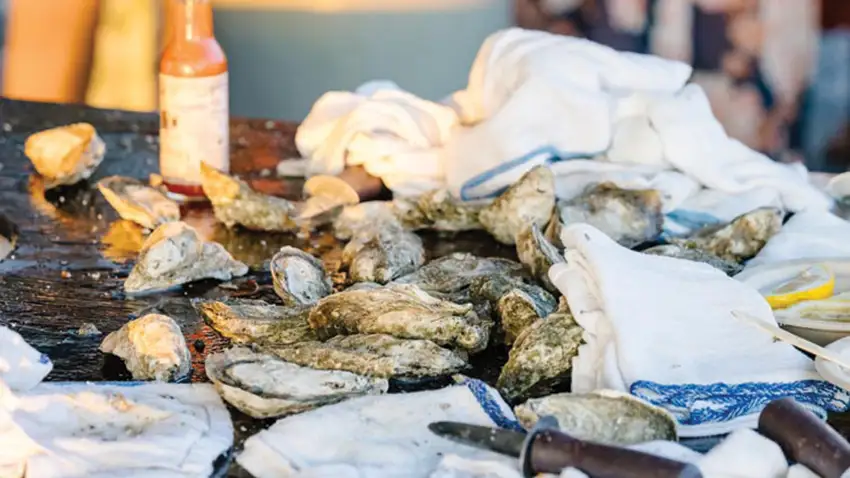
This time of year, Lowcountry oyster roasts and festivals abound, bringing communities together to enjoy the freshly-harvested gifts of the saltmarsh and riverbeds.
To host one at home, serve oysters that are either purchased or scoured from nature. Before heading out at low tide, however, the South Carolina Department of Natural Resources recommends obtaining a license and learning the rules. According to SCDNR, those regulations include, “Harvesting only from approved areas, sticking to the limit of two bushels per person per day, ‘culling in place’ and recycling the shells to protect future reefs.”
Whether store-bought or harvested by hand, oysters should be scrubbed to clear away any mud or dirt. Next, place a metal tray or foil over a hot fire pit and add a layer of the oysters on the scorching surface. Then cover the oysters with a wet burlap sack. While steaming them for eight to 10 minutes until they open, savor the evocative crackling aesthetic of the fire and the aroma of the oysters roasting in the crisp air. Serve with a squeeze of lemon, hot sauce such as Tabasco and saltine crackers.
Indigenous to the area because of the abundance of waterways that traverse the Lowcountry, the tradition of the oyster roast is steeped in a long and fascinating history according to Chris Judge, an archaeologist at the University of South Carolina Lancaster. “I think Late Archaic Indigenous people from 5,000 to 3,000 years ago steamed open oysters in pits. It’s the earliest period we see in oyster diet, due to sea level rise inundation of coastal zones prior to that period,” he said. “Furthermore, oysters are the predominant shell found in rings and middens.”
This prevalence of empty shells embedded in rings and middens or ancient mounds filled with clam, whelk, blue crab and oyster casings that were likely steamed open and consumed by Indigenous people, gives archeologists a glimpse into a mysterious custom. Chairman of the Archaeological Institute of the Pee Dee, Ben Zeigler, explained, “There is a nuance about shell middens and many theories of what they actually were. Some scholars believe they were trash heaps. Others speculate they were sacred ceremonial sites that were cosmologically aligned with the equinox and stars, similar to Stonehenge. Additional arguments suggest that they were the foundation of communities.” Of the 60 shell middens dotting the Lowcountry coastline, Zeigler said, “The prehistoric utilization of shellfish along the South Carolina coast is an important component of archaeology because it has altered the landscape from outside Georgetown to Beaufort.”
In more modern times, from 1566-1587, when the Spanish settled Santa Elena, what is now Parris Island, they complained bitterly about having to eat oysters to stay alive since there was no other sustenance, Zeigler said. Conversely, later settlers from England and France continued to relish fresh oysters as their European ancestors had done for thousands of years.
Zeigler, who served as an avocational archaeologist for the Francis Marion Trail Commission from 2006- 2009, added that later evidence of Lowcountry oyster roasts has recently been discovered along the Pee Dee River at Dunham’s Bluff. That location, he said, is significant because it was the site of Francis Marion’s late 18th century camp, which was so impenetrable that it has become enshrined in a Sherwood Forest-like iconography. He added, “Digs at Dunham’s Bluff have yielded remnants of fire pits containing the bones of fall and winter ducks, waterfowl, deer, turkey, game, pigs, chicken, cows and lots of oyster shells. It’s remarkable how these soldiers were able to sustain themselves with plenty of food, holding oyster roasts in the swamps while fighting the British.”
Although the practice dates back thousands of years, the earliest documentation of an oyster roast in the Lowcountry wasn’t until 1897. Held at Remley’s Point, the Grand Lodge of Ancient Masons hosted the event.
As the timeless tradition of the oyster roast continues today and for generations to come, it is perhaps explained best by putting on a pair of gloves and shucking a cluster for yourself.
By Sarah Rose


Leave a Reply